
Malahat Macro-Network Planning
The ultimate goal of Malahat Macro-Network Planning is to have the entire Nation, houses and offices, connected together in a mesh layout. This enables Malahat to retain ownership of our networking infrastructure while providing free, fast internet access to our members. Other benefits include security oversight, IoT opportunities, and significant cost savings in the long run.
This project will roll out in phases and is subject to change. Phases can be implemented simultaneously and the order is not important.
Phase 1 - Inter-building connectivity in upper cluster
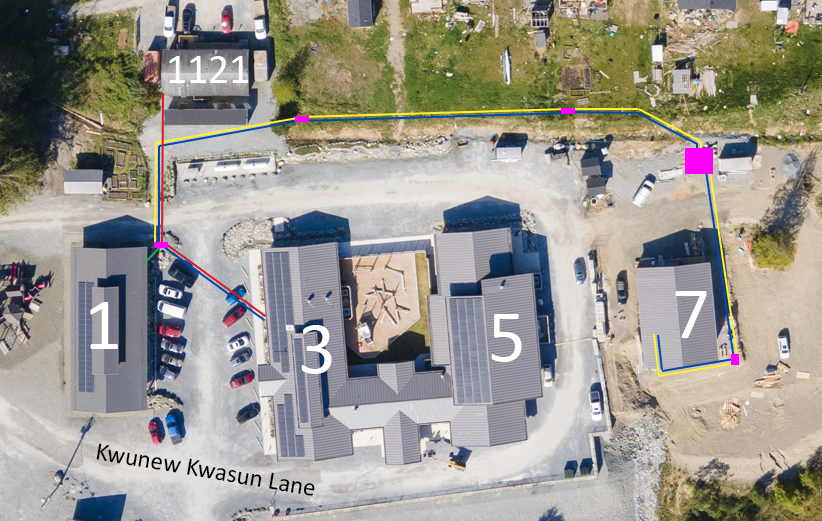
We currently have all 5 upper cluster addresses connected via conduit as shown above. The external connection comes from Shaw and runs into 3 Kwunew Kwasun Lane. From there, the connectivity is distributed to 5 & 7 Kwunew Kwasun Lane, and 1121 Jesken Road. 1 Kwunew Kwasun still needs to be connected to the network, but the conduit is installed and ready to go. See below for a more zoomed out version of the above photo.
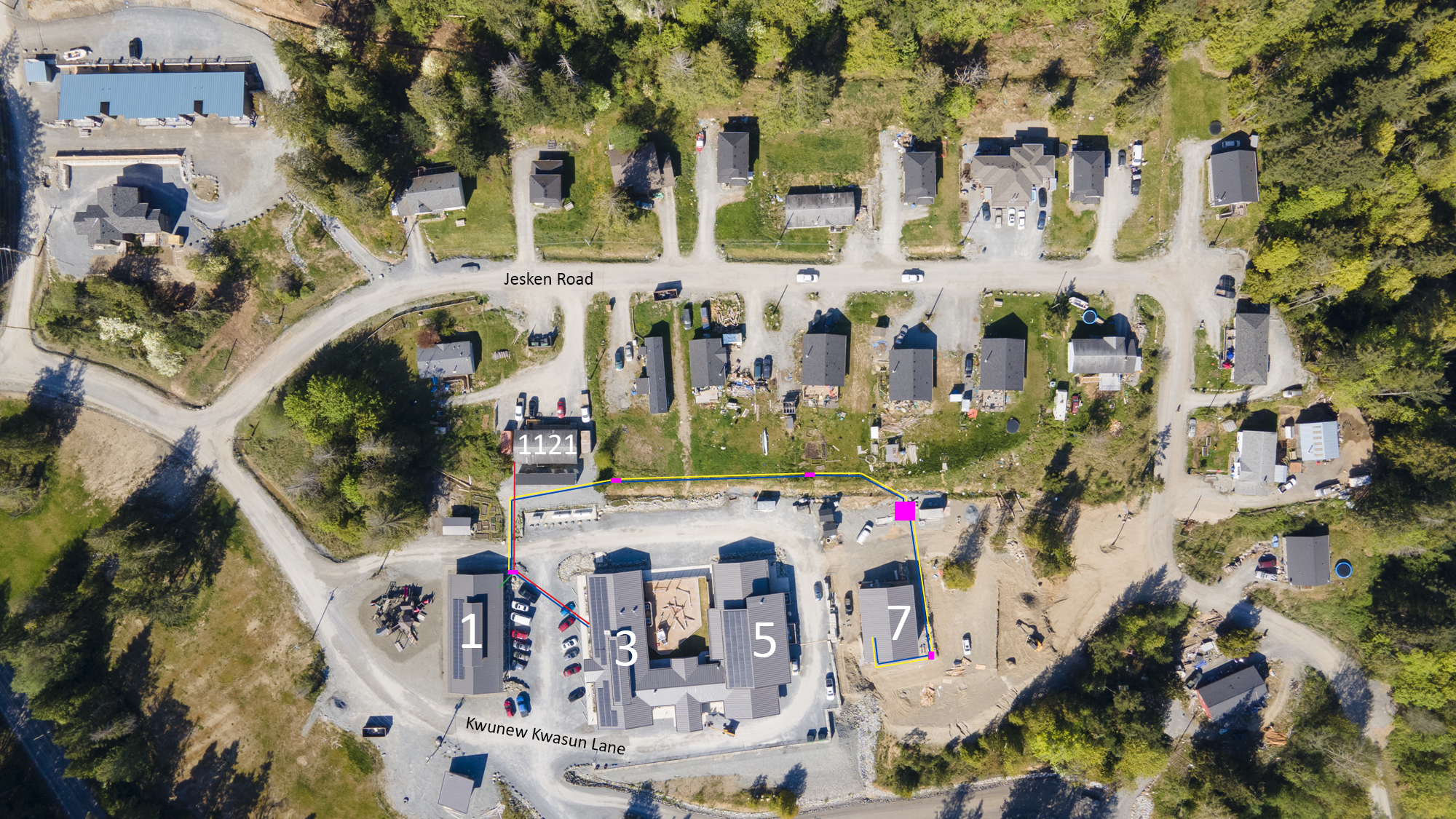
These connections are currently based on copper cabling (CAT6) and can support speeds approaching 1Gbps up to 300ft. The connection between 3 KKL and 7KKL is longer than 300ft and is subject to a small amount of bandwidth degradation. To complete Phase 1, we will need to replace these copper cables with fibre optic cables which have far higher range and bandwidth limitations.
Estimated cost to replace copper cables with fibre: $10,000
Potential Funding: https://www.cira.ca/community-investment-program/grants
Phase 2 - Broad Wireless Network
The most cost effective way to connect existing houses (and satellite offices) to our network is using a wireless broadband system such as https://www.radwin.com/ptmp-jet-series/
These carrier class point-to-multipoint networks consist of a base station which broadcasts a special kind of wireless signal. This is not like regular WiFi; it is designed to go much farther, similar to 5G. The downside of these systems is they require special "subscriber units" to receive the signal. These units are installed in the home like a modem, they receive the wireless signal and convert it to regular WiFi that regular devices can make use of.